GEO vs SEO: What's the Difference, and Why Businesses Need Both
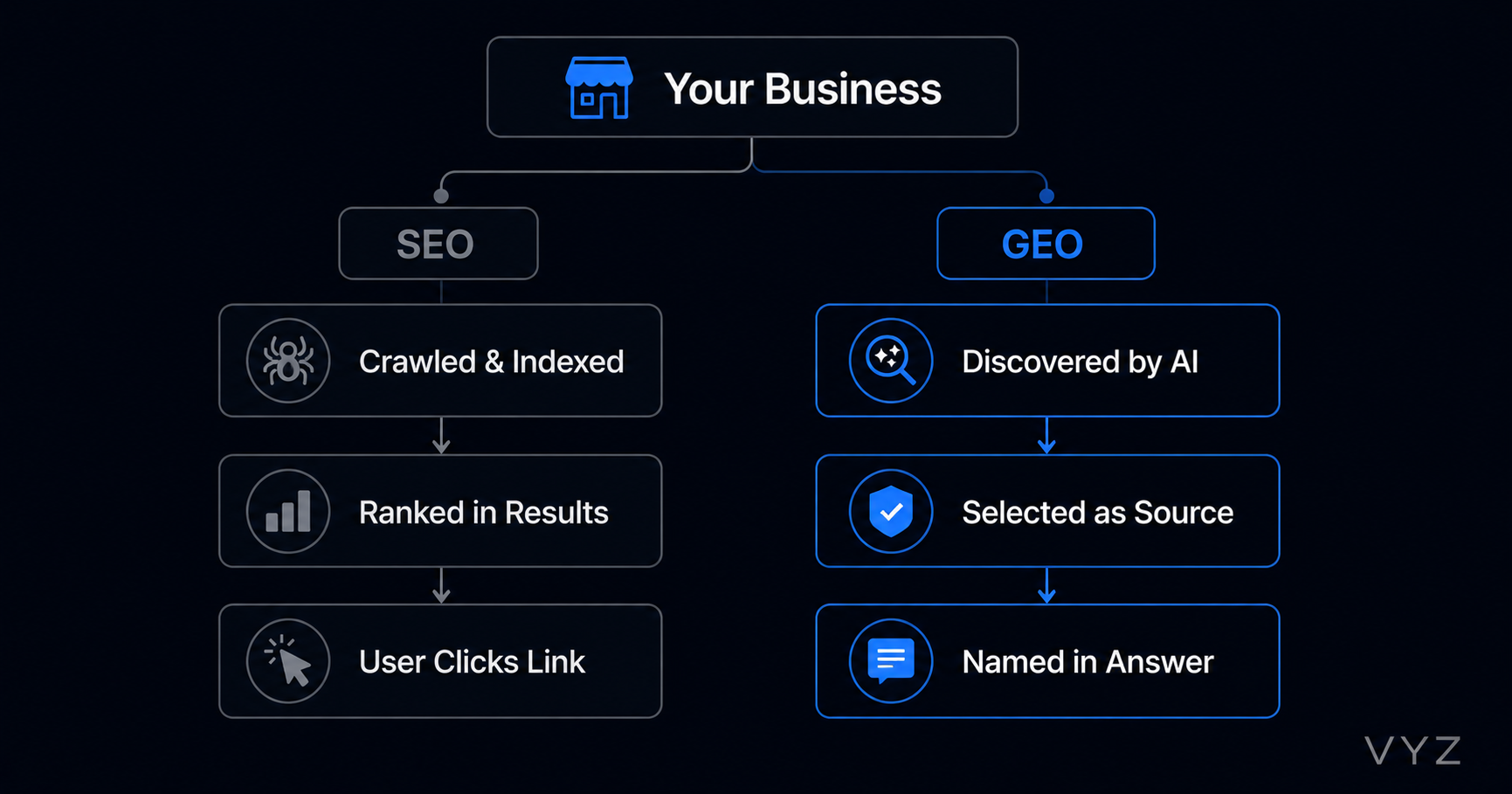
SEO helps your business get found. GEO helps it get cited in AI answers. These are two different channels with two different mechanics — and most businesses are optimizing for one while completely ignoring the other.

TL;DR
SEO and GEO are not the same thing, but they are not opposites either. SEO builds the infrastructure that makes your business discoverable, credible, and indexable. GEO increases the likelihood that AI tools will select, cite, and recommend you when customers ask for help. Both depend on the same underlying foundations. Neither alone is enough anymore.
Search is shifting from links first to answers first.
The way customers find businesses is changing. Millions of people who used to type a query into Google and click a link are now asking ChatGPT, Gemini, Perplexity, and Claude for recommendations directly. The answer they receive is synthesized. It names businesses, describes options, and makes judgments — without the user ever visiting a search results page.
This is not experimental. ChatGPT handled more than one billion web searches in a single week as of early 2025 and had over 400 million weekly active users. Google's AI search features expanded from seven countries to 229 in a single year. Consumers are already using AI for adjacent high-intent tasks: shopping, health decisions, travel, and service comparisons.
The commercial problem is simple. If a customer asks an AI tool for the best option in your category in your city, and your business is not in the answer, that customer is gone. No impression, no click, no chance to convert. The issue is not that AI replaces Google — it is that a growing share of answers now gets resolved before anyone clicks anything.
~1 in 100
searches featuring an AI summary result in a link click, per a large Pew Research analysis
Pew Research / The Guardian, 202515%
estimated daily traffic reduction to Wikipedia pages exposed to Google AI Overviews, in a causal 2026 study
Academic difference-in-differences study, 202630%
of AI Overview-cited domains in one 2026 study did not appear in the co-displayed first page of Google results
AI source selection study, 2026
What SEO still does for a small business
SEO did not become obsolete. Google still drives enormous amounts of commercial traffic, and the fundamentals of SEO — crawlability, indexation, service page quality, local listings, and reviews — are the same foundations that AI visibility depends on. A business with weak SEO will also have weak GEO. That is not a coincidence.
For local businesses, the core SEO essentials remain the same: a site Google can crawl and index, service pages that match what customers actually search for, a complete and accurate Google Business Profile, reviews on platforms that carry authority, and consistent business information across the directories that matter. None of that has changed.
What has changed is that passing these checks is no longer enough to be visible everywhere your customers are looking. SEO gets you eligible. It does not get you recommended.
What GEO means in this article
GEO stands for Generative Engine Optimization. It means improving the chance that your business is mentioned, cited, or recommended when someone asks an AI tool for help. That includes ChatGPT, Gemini, Claude, Perplexity, Google's AI Overviews, and any other AI surface that synthesizes answers from web content.
GEO does not mean geofencing, geotargeting, or location-based ad campaigns. That is a different discipline entirely. GEO is about answer-layer visibility — whether AI tools will include your business when they build a response for a high-intent query in your category.
It is also not a magic shortcut. There is no GEO hack that gets you into ChatGPT answers if your business information is thin, unverified, or hard to extract. GEO is an extension of discoverability into a new interface, not a workaround for poor fundamentals.
"SEO makes you eligible. GEO helps make you selectable."
Where SEO and GEO overlap
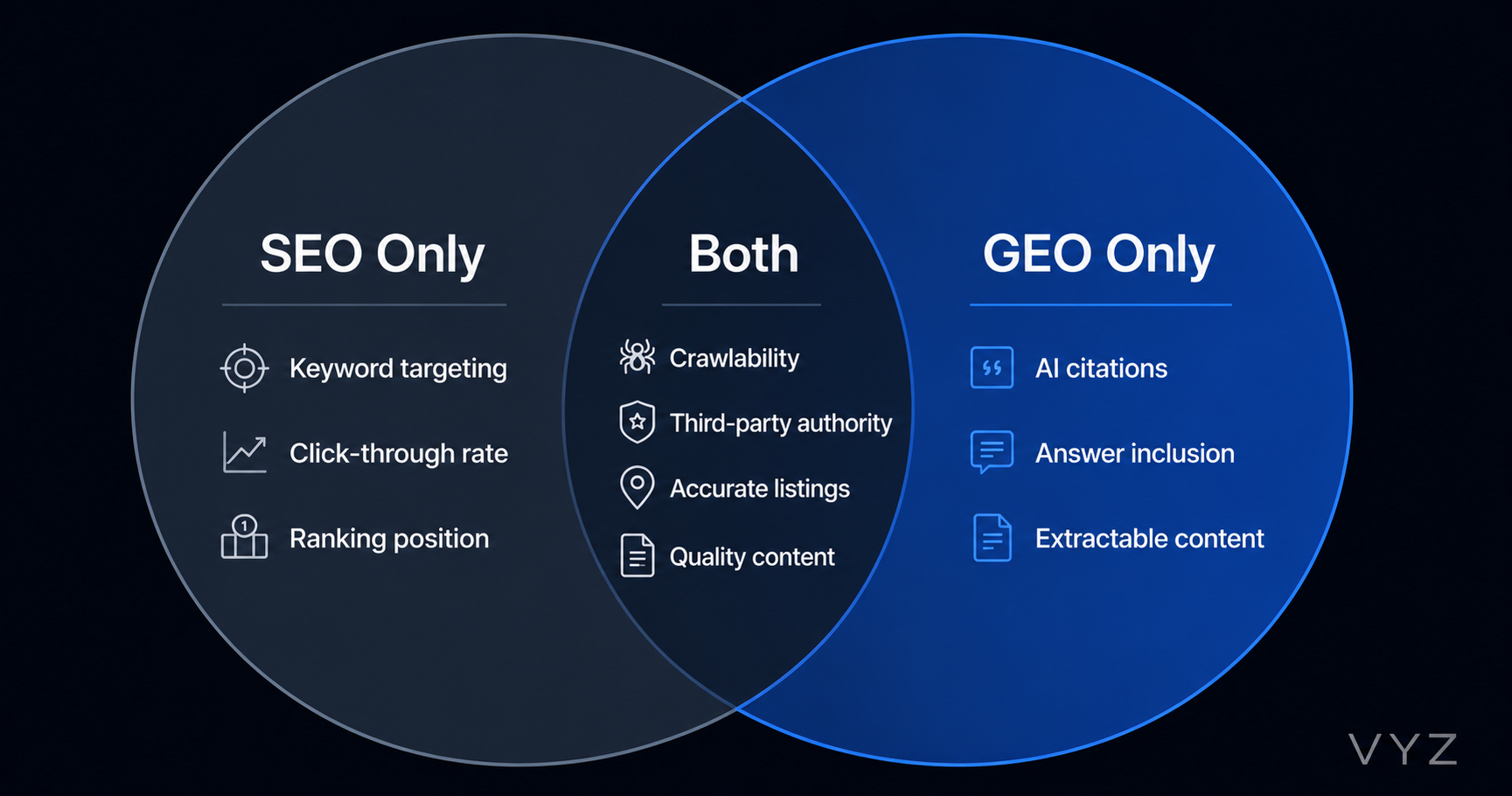
The overlap is larger than most people expect. Both SEO and GEO depend on the same underlying web foundations: your site must be crawlable, your content must be publicly accessible, your business information must be accurate, and your presence must be backed by genuine third-party evidence.
Independent research on AI citation behavior consistently shows that AI search systems favor earned media and third-party authority over brand-owned marketing pages. A page with reviews, external mentions, structured data, and specific service information performs better in AI answers — the same signals that help with local SEO. The mechanisms are different, but the inputs often rhyme.
High-influence cited pages in AI answers tend to be longer, more structured, and richer in specific facts, comparisons, and definitions. That is also what Google rewards for featured snippets and People Also Ask boxes. The disciplines are not identical, but they reward the same underlying qualities: clear, specific, evidence-backed content.
Where SEO and GEO differ in practice
The core difference is what a successful outcome looks like. SEO is about earning a ranked position and getting a click. GEO is about being selected into a synthesized answer, even when fewer users click on anything at all.
The click suppression data is clear. A Pew Research analysis of nearly 69,000 Google searches found that users clicked a link under an AI summary roughly once per 100 searches. A 2026 causal study estimated that AI Overview exposure reduced daily traffic to Wikipedia pages by around 15 percent. MailOnline reported a 56 percent drop in click-through rates on queries featuring AI summaries.
That does not mean SEO becomes worthless. It means that ranking well in traditional search is no longer the whole game. A business can rank strongly and still miss the answer layer entirely. In one 2026 study, approximately 30 percent of AI Overview-cited domains did not appear in the co-displayed first page of Google results at all. A separate study measuring source overlap between classic Google, Gemini, and AI Overviews found average Jaccard similarity below 0.2 — meaning the sets of sources are largely different.
| Dimension | SEO | GEO |
|---|---|---|
| Primary goal | Earn strong visibility in ranked search results and local surfaces | Be cited, recommended, or absorbed into AI-generated answers |
| User experience | User scans results and chooses a link to click | User gets a synthesized answer first, often without clicking |
| Best-fit content | Service pages, location pages, category pages | Answer-ready pages, FAQs, comparisons, trust assets |
| Failure mode | You do not rank, or rank too low to earn traffic | You rank but are not selected or cited in the answer |
| Success event | Impressions, clicks, calls, form fills | Brand mention, citation, recommendation, AI referral visit |
What a small business should do now
Fix the shared foundation first, then add the answer-layer work on top. GEO improvements built on a weak SEO base are unstable and hard to sustain. Businesses that skip the basics and chase AI-specific hacks tend to underperform in both channels.
There is some directional evidence that getting this right matters commercially. A 2026 study of more than 850,000 websites found that AI-crawled sites generated 320 percent more human traffic, 2.7 times more form submissions, and 2.5 times more click-to-call events than sites with less AI visibility. That is vendor research and should be treated as associational rather than causal — but the direction is consistent with the broader picture.
Shared foundation
- Confirm Google and Bing indexation for core pages
- Make critical service content available in clean HTML
- Complete and maintain your Google Business Profile
- Standardize NAP and hours across major directories
- Build a review-response process, not just review acquisition
Answer-ready content
- Add service explainers that answer real customer questions
- Create comparison content for best-for and who-should-choose prompts
- Add credentials, service area, process steps, and transparent pricing guidance
- Make pages quotable: definitions, numbers, brief lists, plain-language steps
Third-party evidence
- Local directories, association listings, and review platforms
- Press mentions and partner citations
- Track whether the business appears in a fixed prompt set over time
- Tie AI visibility work back to actual conversions, not just screenshots
Budget guidance
In the first 90 days, spend roughly half your budget on shared foundation work. That investment pays dividends in both channels. Reserve around a quarter for answer-ready content improvements, and the remainder for building third-party evidence and setting up basic measurement. GEO without measurement is just guessing.
GEO does not replace SEO. It extends it.
Businesses that skip SEO foundations and chase GEO tactics are likely to underperform in both channels. Businesses that keep doing only classic SEO and ignore AI answer visibility are already losing customers to competitors who show up in responses they never see.
The goal is not to game AI. It is to become the business the web already has enough evidence to recommend. That means being discoverable, being trusted, and being easy to cite. Those are the same goals SEO has always pursued. GEO just makes the stakes for reaching them higher.
Free AI visibility audit
Find out where you stand in AI answers.
See your exact visibility score across ChatGPT, Claude, Gemini, and Perplexity. Find out where competitors are appearing and you are not, for free.
Get My Free AI AuditNo credit card. No sales call. Just your results.
Stay ahead of AI search.
Each week we send one email covering what is changing in GEO, practical tactics for improving your AI visibility, and what the research is actually saying.
One email per week. No spam. Unsubscribe any time.