How Does ChatGPT Choose Which Businesses to Recommend?
There is no single public ranking formula. But independent research now points to a consistent three-layer pattern: eligibility, authority, and extractability. Here is what that means, what the evidence actually supports, and what local businesses can do about it.

TL;DR
ChatGPT does not use one ranking formula. The public evidence points to three things working together: the business must be findable on the web, it must look credible through third-party sources, and its information must be easy for an AI to extract and explain. Improving all three raises your chances of being recommended. Improving only one rarely moves the needle.
It is not one thing. It is three.
When a user asks ChatGPT for a recommendation (the best plumber in their city, a nearby dental clinic, a software tool for their team), the answer they receive is not pulled from a simple ranked list. It is a synthesized response built from multiple layers of data, filtering, and reasoning.
The public evidence, drawn from academic research on generative engine optimization and related AI search studies, consistently points to a layered process. A business must first be discoverable. Then it needs to look credible to the platform. And the information on it must be easy for an AI system to extract, compare, and use to justify a recommendation.
None of these layers works in isolation. A business that ranks well in traditional search but has no meaningful third-party coverage can still be invisible in AI recommendations. A business with great reviews but an incomplete, hard-to-parse web presence faces a different version of the same problem.
Can ChatGPT find you at all?
A business must be discoverable and current on the web. That means being indexed, having complete listing data, and staying visible in the upstream search and data ecosystem that AI tools draw from.
Does ChatGPT have reason to trust you?
Third-party mentions, reviews, publisher coverage, and directory presence all signal that a business is real and credible. AI systems favor earned authority over brand-owned marketing pages.
Can ChatGPT easily describe you?
A business needs to make it easy for an AI system to compare, summarize, and justify a recommendation. Clear service descriptions, explicit comparisons, and structured facts all help.
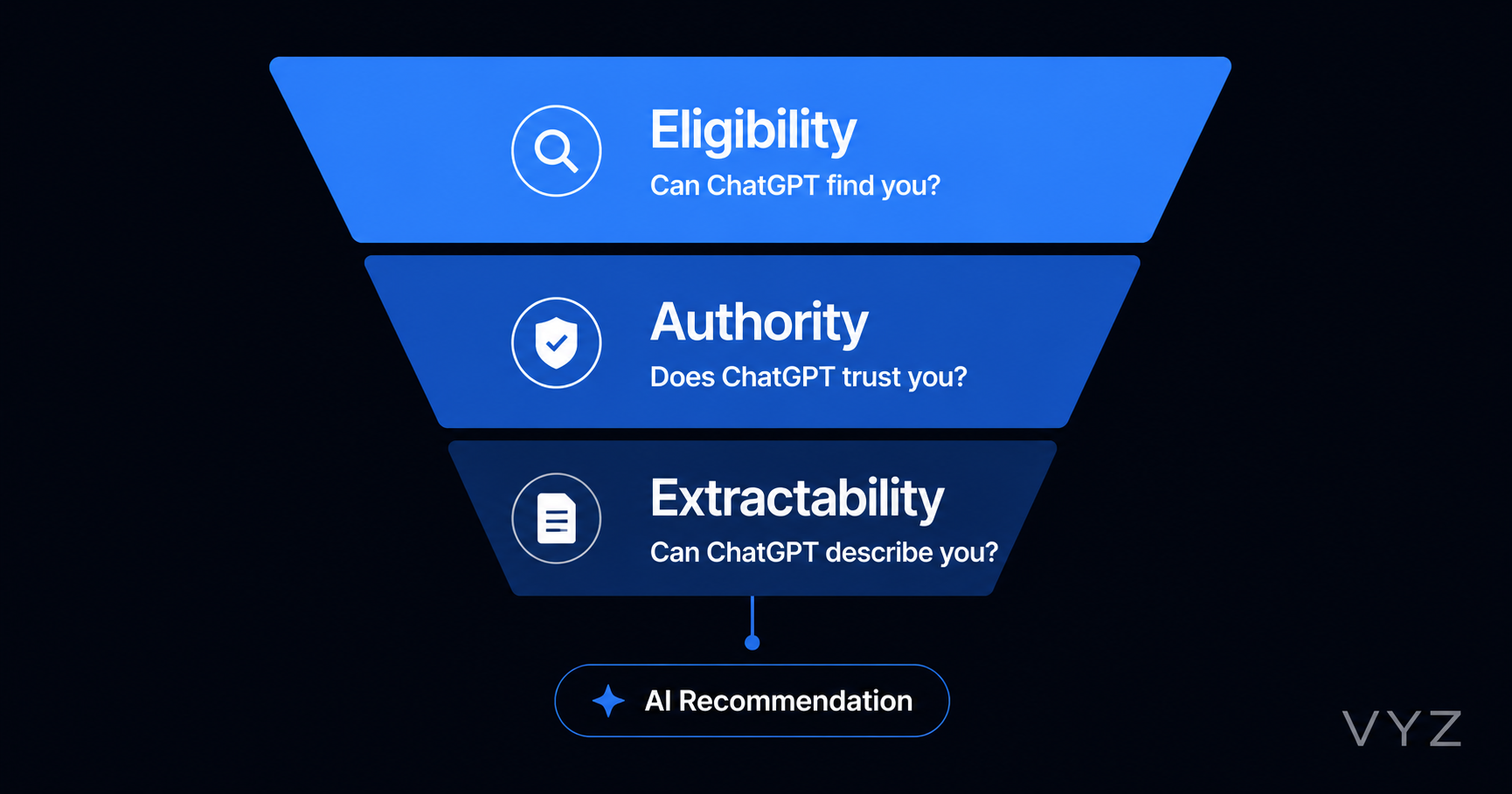
Eligibility: can ChatGPT find you at all?
Before ChatGPT can recommend a business, it needs to know the business exists. For web-connected responses, that means the business must be present in the upstream search and data layer that AI tools draw from. A business that is not indexed, not listed, or not current in major directories simply cannot appear in a recommendation. It was never eligible to surface in one.
Eligibility is the floor, not the ceiling. Passing this layer does not guarantee a recommendation. It only means the AI has access to your information. But failing it is an automatic disqualification, regardless of how strong everything else is.
The practical implication is that the basics matter more than most businesses assume. A Google Business Profile with outdated hours, a Bing Places listing that was never claimed, or a website that has not been updated in two years all create gaps in eligibility. These are fixable problems, and they are often the fastest wins available.
Extractability: can ChatGPT easily describe you?
Even a business that clears the eligibility and authority layers can still lose a recommendation if the AI cannot easily extract and explain why it fits the query. A 2026 study analyzing citation behavior found that pages with higher answer influence tended to be longer, more structured, semantically aligned with the query, and rich in extractable evidence: specific facts, comparisons, statistics, and clear descriptions of what the business does.
This is the layer most businesses overlook. It is not about keywords or link counts. It is about whether an AI system can read your content and quickly build a justified answer from it. If your service page is a vague paragraph of brand language, there is nothing concrete to extract. If your FAQ section already answers the questions buyers ask AI, the recommendation becomes almost automatic.
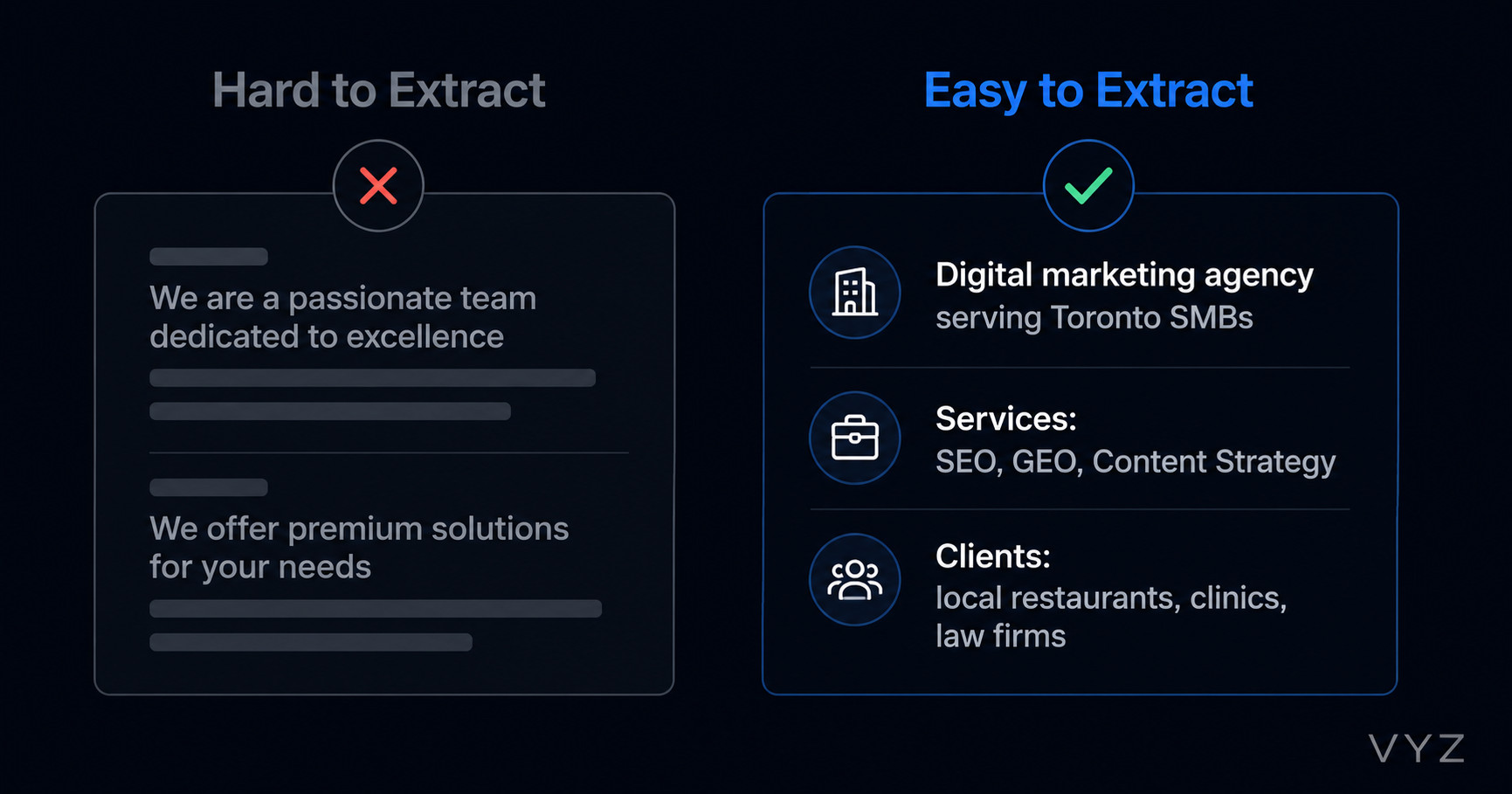
The extractability layer is also where content format decisions have the most direct impact. Clear headings, explicit service descriptions, named geographic areas, defined client types, and comparison-style content all help. They do not just make pages more readable for humans. They make them easier for AI systems to use as justification material when building a recommendation.
What the research actually says
Independent academic work on generative engine optimization is now substantial enough to draw real conclusions from, but still young enough that precision matters. The most established anchor is a paper accepted at the KDD 2024 conference, which showed that specific content changes (adding citations, quotations, and statistics) could increase AI surface visibility by up to 40 percent in controlled benchmarks.
Newer 2025 and 2026 studies extend that picture. AI search engines appear to favor earned media, show meaningful differences between platforms, and prefer content that is structured, scannable, and comparison-friendly. Importantly, the research also finds that smaller regional businesses face a structural disadvantage. SOCi's 2026 Local Visibility Index, which audited more than 350,000 business locations across 2,751 brands, found that ChatGPT recommends just 1.2 percent of local business locations, meaning 98.8 percent are completely invisible to AI search.
The evidence base is still early. There is no published study that cleanly isolates a ChatGPT local-business ranking formula. But the pattern across multiple independent research groups is consistent enough to act on.
Up to 40%
visibility increase from content interventions like adding citations, quotations, and statistics
GEO paper, KDD 20241.2%
of local business locations recommended by ChatGPT in an audit of 350,000+ locations across 2,751 brands — meaning 98.8% were completely invisible
SOCi Local Visibility Index, 20261.82x
estimated lift in ChatGPT referral traffic from a defined optimization intervention in one field study — the researchers note the effect is suggestive and based on a single domain
AEO field study, arXiv 202675%+
of ChatGPT-cited sources in health-domain prompts came from established institutional sources
Authority signals study, arXiv 2026On-site vs off-site factors
The work splits into two buckets: what you control on your own website, and what happens across the rest of the web. Both matter. Neither is enough on its own.
On your website
- Complete, accurate business information on every page
- Explicit comparisons between services or alternatives
- FAQ-style content that mirrors how buyers ask questions
- Clear service area and who you serve
- Structured details that can be extracted and compared
Across the web
- Reviews on Google, Yelp, and industry directories
- Mentions in reputable third-party publications
- Listicles and roundups that name your business
- Consistent directory listings across the web
- Publisher coverage from recognizable sources
Great content alone is not enough. Neither is a strong off-site presence. The businesses that appear consistently in AI recommendations tend to have both: clear, structured, extractable information on their own pages, backed by genuine third-party coverage that gives AI systems reason to include them.
The role of schema markup
Schema markup, specifically LocalBusiness, FAQPage, and Review schema, gives machines a structured way to interpret business facts: address, opening hours, service area, aggregate rating, price range. These are exactly the kinds of facts an AI system would want to parse when deciding whether a business fits a recommendation.
The strongest claim the current evidence supports is that schema is enabling infrastructure. It removes ambiguity about what a business is and where it operates. Multiple AI-search studies recommend machine-readable, structured content and mention schema as a practical step toward better extractability.
What the public evidence does not yet show is a clean causal experiment proving that adding LocalBusiness or FAQPage schema alone increases ChatGPT recommendation frequency. That distinction matters. Schema helps machines understand you. It does not guarantee that they will recommend you. That still depends on the authority and extractability layers holding up.
Reviews and third-party authority
Reviews matter in AI recommendations, but not in the simple way most businesses assume. The mechanism is not that more five-star reviews trigger a ChatGPT ranking boost. The mechanism is that reviews strengthen a business's authority footprint across the web, and AI systems appear to weight that footprint heavily.
Google's own local ranking guidance states that more reviews and positive ratings can help local prominence. According to OpenAI's own announcement, ChatGPT shopping results are based on structured metadata from third-party providers, including pricing, product descriptions, and reviews. Yelp confirmed in a February 2026 press release that it signed a data licensing agreement with OpenAI, covering 330 million reviews, 500 million photos, and more than 8 million business listings. Yelp's stated position on that deal is that users want the underlying review evidence shown alongside AI recommendations. People want AI to be transparent about where its data comes from.
A practical reading of all this: reviews help when they strengthen your third-party presence in directories and review platforms that AI tools either draw from directly or use as upstream credibility signals. A business with genuine, current reviews across multiple platforms gives AI systems more evidence to work from than a competitor with a single source of social proof.
The important nuance
There is no public direct weighting model that maps review count to ChatGPT recommendation frequency. That is an inference from the available evidence, not a disclosed platform rule. Avoid treating star ratings as a switch. Treat reviews as one part of a broader authority and credibility strategy.
Upstream search access is necessary, not sufficient
For web-connected ChatGPT responses, upstream search indexing is the foundational access layer. A business that is not findable in the search and data infrastructure that AI tools draw from cannot appear in the recommendation at all. That makes indexing, listing completeness, and crawlability essential prerequisites.
But ranking well in traditional search does not automatically translate to AI visibility. Independent research consistently finds that AI search systems diverge from ordinary web search in their source mix, domain selection, and content preferences. The overlap between what ranks on Google and what gets cited by ChatGPT is lower than most marketers assume.
The best inference from the available evidence is this: upstream search visibility is the access layer. ChatGPT then applies its own filtering based on authority, extractability, and fit to the specific query. A business that ranks well in traditional search but lacks third-party authority and structured content will often be visible enough to surface in the AI retrieval stage but still lose out at the recommendation stage.
A practical playbook for local businesses
The three-layer model translates directly into a prioritized action list. These steps are evidence-aligned, not speculative.
Keep listings complete and current
Google Business Profile, Yelp, Bing Places, and industry directories are all upstream sources AI tools draw from. Incomplete or outdated listings create gaps.
Make pages comparison-friendly
AI systems build shortlists. Pages that explicitly compare services, explain who you help, and state what makes you different are far easier to cite.
Publish clear service FAQs
FAQ-style content mirrors how buyers ask AI questions. If your pages already answer those questions, AI has less work to do when deciding whether to recommend you.
Pursue third-party mentions and reviews
Earned media matters more than brand-owned pages in AI recommendation systems. Reviews, press mentions, and directory coverage all strengthen your authority footprint.
Track AI referrals separately
Standard organic search dashboards do not show ChatGPT traffic. Monitor AI referrals as their own channel so you can actually measure whether your visibility is growing.
Where to start
The fastest starting point is an AI visibility audit. Run the actual queries your buyers use. See which competitors are appearing. See how your business is described when it does show up. That baseline tells you which layer is failing first, and that is where the highest-leverage work is.
Free AI visibility audit
Find out which layer is failing you.
See your exact visibility score across ChatGPT, Claude, Gemini, and Perplexity. Find out where competitors are appearing and you are not, for free.
Get My Free AI AuditNo credit card. No sales call. Just your results.
Stay ahead of AI search.
Each week we send one email covering what is changing in GEO, practical tactics for improving your AI visibility, and what the research is actually saying.
One email per week. No spam. Unsubscribe any time.