What is GEO?
In AI-search marketing, GEO stands for Generative Engine Optimization: the work of making your brand easier for AI systems to find, understand, cite, and recommend. This article breaks down what it means, how it differs from SEO, and why it matters for your business.

TL;DR
GEO stands for Generative Engine Optimization. It is the work of getting your brand included inside AI-generated answers, not just ranked on a results page. If you are not doing this yet, your competitors might already be.
GEO as Generative Engine Optimization
Generative Engine Optimization is the practice of improving how often AI systems include your brand, website, and facts in generated answers. The goal is not only to rank. The goal is to be retrieved, trusted, cited, mentioned, and summarized when someone asks an AI tool for help.
That distinction matters because AI interfaces do not behave like a traditional search-results page. A user can ask ChatGPT, Gemini, Claude, Perplexity, or Google AI Overviews a question and receive a synthesized answer before they ever click a link. GEO is about earning a place inside that answer.
The term gained traction with the 2023 research paper "GEO: Generative Engine Optimization," which described optimization strategies for improving visibility in generative-engine responses. For businesses, the practical takeaway is straightforward: content needs to be extractable, attributable, technically accessible, and backed by signals that make the brand easy to verify.
"The goal is not to rank on a results page. The goal is to be included inside the answer itself."

How GEO differs from traditional SEO
SEO is still foundational. Search engines, crawlers, knowledge graphs, third-party mentions, and technically healthy pages all shape whether AI systems can understand you. GEO builds on that foundation, but it uses a different scoreboard.
Traditional SEO focuses on rankings, impressions, and clicks from search results. GEO focuses on inclusion, citation, attribution, sentiment, and recommendation inside AI-generated answers. A brand can have strong Google rankings and still be invisible when an AI assistant recommends providers, products, restaurants, clinics, agencies, or tools.
Category
Traditional SEO
GEO
Primary goal
Rank high on Google search results
Appear inside AI-generated answers
Success metric
Position 1-10, click-through rate
Citation, mention, recommendation frequency
Optimization target
Search engine crawlers and algorithms
LLM retrieval and reasoning systems
Content format
Keyword-optimized pages and headings
Answer-ready, entity-clear, attributable content
Key signals
Backlinks, page authority, technical health
Third-party mentions, verified facts, source quality
Output
Blue link on a results page
Named or described inside a generated response
Good GEO work tends to improve entity clarity, topical authority, answer-ready structure, source quality, and third-party validation. It is less about tricking an AI model and more about removing ambiguity from the web around who you are, what you do, who you serve, and why you should be trusted.
How AI systems decide who to recommend
AI language models are trained on massive amounts of web content. They learn patterns about entities — businesses, people, products, places — based on how consistently, clearly, and credibly those entities are described across the web. When a user asks for a recommendation, the model draws on those learned patterns.
This means the signals AI systems use are more about information quality and coverage than pure link authority. A business with fewer backlinks but highly consistent, well-structured, third-party-verified information can outperform a competitor with higher domain authority in AI recommendations.
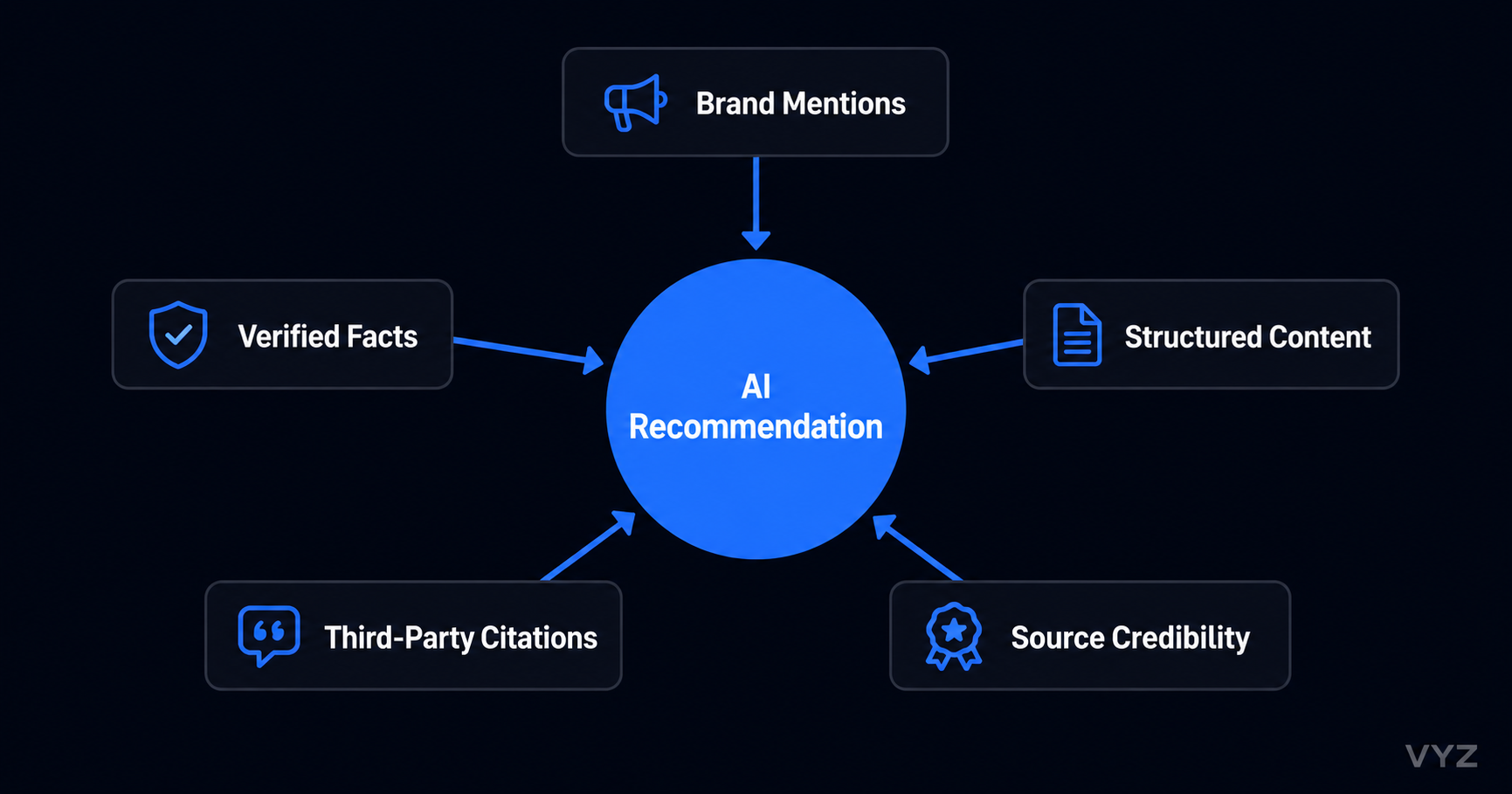
For retrieval-augmented AI tools like Perplexity, Bing AI, and Google AI Overviews, real-time web search also plays a role. These systems pull live sources to supplement their answers, which means staying current and citable matters as much as long-term brand signals.
What GEO means for your business
If your customers are asking AI systems for recommendations, comparisons, or local options, GEO is now part of your visibility strategy. The question is no longer only "Do we rank on Google?" It is also "Do AI systems understand us well enough to recommend us?"
The strongest starting point is an AI visibility audit: test the prompts your buyers actually use, see which competitors appear, inspect how your brand is described, and identify what proof points AI systems can and cannot find. From there, GEO becomes a focused process of improving the content, structure, citations, and authority signals around your brand.
Key takeaways
- GEO stands for Generative Engine Optimization — the practice of getting your brand included in AI-generated answers.
- GEO is not a replacement for SEO. It changes the goal from ranking on a results page to being included in an AI-generated answer.
- Strong GEO work makes content easy to extract, attribute, verify, and connect to a clear brand or entity.
- The businesses showing up in AI answers today built that presence intentionally — it does not happen by accident.
Free AI visibility audit
Find out where you stand today.
Your competitors may already be showing up in AI recommendations. See your exact visibility score across ChatGPT, Claude, Gemini, and Perplexity, for free.
Get My Free AI AuditNo credit card. No sales call. Just your results.
Stay ahead of AI search.
Each week we send one email covering what is changing in GEO, practical tactics for improving your AI visibility, and what the research is actually saying.
One email per week. No spam. Unsubscribe any time.